Monday, June 10, 2013

Education

As a student of government, educated by experience, I have long held the belief that public education is among the most important functions of state government.  Unfortunately, more and more it appears my belief in education as the future of Texas is not shared by the leadership of state government today.

The founders of Texas thought the support of education important enough to enshrine it in our state's constitution.  The Constitution provides that the Legislature provide for a sufficient system of funding for public education.  It is clear the Constitution does not provide responsibility of funding public education on the shoulders of cities, counties or independent school districts. 

The Legislature has apparently ignored the recent finding of an Austin district court that the current system of funding public education is unconstitutional.  The court recently ruled our current system does not meet the mandate of our state's constitution.

It is absolutely clear that the Legislature, in its slavish dedication to no new taxes, has continued to shift the burden of funding of public education to local government--local school boards, homeowners and business owners--in the form of property taxes.  To any observer, our current system of local taxation is patently unfair.  It rewards those with the least tax burden to raise the greatest amount of funding available per pupil while those making the greatest effort produce the least amount for educating the pupils in their districts.

There is adequate evidence from past sessions wherein Republican priorities lie.  During a floor debate over making temporary business tax breaks permanent, Senator Rodney Ellis pointed out the measure would take hundreds of millions away from education.  The answer to Senator Ellis' question from the Republican side was, “We have done it for the past four years!”  There seemed to be little concern that reducing the state's efforts for public education continues to shift more of the burden to local property owners.

The conservative leadership placed in charge of public education this past session, at least in the Senate, has exacerbated the shortage of funding for public education by condoning an almost unlimited increase in the number of charter schools.  Charter schools are funded throughout the state at a higher rate per pupil than are independent school districts.  Every newly created charter school takes away funding which otherwise could be available to support public education in our state.  

Not only do charter schools dissipate the amount of funding at the state level, they take away funding which would otherwise be allocated in the local district on a per-pupil basis from the public schools.

The greatest hope for advocates of adequately funded public schools is that the recent court ruling will be upheld in the direct appeal to the Supreme Court of Texas.  I have serious doubts the current makeup of the Texas Supreme Court will offer great hope in this regard.  A majority of the current Court has been appointed by our current governor, Rick Perry, who stoutly maintains public education is already adequately funded.  

Today's Texas Supreme Court is vastly different from the one which first ruled that Texas' public education was unconstitutional.  That court was led by former Senator Oscar Mauzy who had served two terms as chairman of the Senate Education Committee.  Oscar Mauzy was long a champion of a quality of opportunity and firmly believed the future of Texas was tied to the quality of education we delivered to future generations.  Time will only tell whether or not current justices of our supreme court share the vision of Oscar Mauzy and others dedicated to the future of public education.

Forfeiture


Recently, Hearst News started a series on the federal government procedure of forfeiture of assets.  The news articles reveal assets are often forfeited from people innocent of any crime and without judicial review. Hearst News’ effort to inform the general public of what is an unfair, undemocratic practice is commendable. Most folks know very little about forfeiture, only having heard of it as an effective law enforcement tool.

Federal law provides that any property used in criminal efforts may be forfeited. After the forfeiture, the proceeds of the forfeiture are shared not only by the federal authorities but also by local government involved in the seizure.

Few Americans know the extent to which forfeiture can be abused, robbing innocent citizens of their properties. One of the leading cases in forfeiture took place when a group of people purchased a large ship, a freighter. Unfortunately for the owners, they leased it to a South American concern who sublet the large vessel. Apparently, the people subletting from the leaseholders used the freighter to transport a ship load of marijuana. Federal authorities took the valuable vessel from its owners without notice.

When the true owners of the vessel discovered they had been deprived of their property, via the criminal forfeiture statute, they appealed ultimately to the Supreme Court of the United States who ruled the forfeiture was valid even though no notice of forfeiture had been given to the true owners of the vessel.  The only real appeal owners of forfeited property have is to appeal to the good graces of the Justice Department or U.S. Attorney.

In my view there are several problems with this procedure.  First and foremost, property of people who have never committed a crime can be taken with little or no judicial review of the circumstances or fairness of the forfeiture. Second, with forfeiture, police agencies are given an independent source of revenue uncontrolled by any elected official.

Glaring examples can be found locally in Jefferson County’s past in which several thousand dollars of forfeited funds were used not to chase crooks but to re-carpet sections of the then district attorney’s office. In Williamson County, the county adjoining Austin, Texas, a prosecutor once used forfeited funds to purchase an antique automobile. The prosecutor justified this purchase by saying he could use it to attract the attention of young people in order to lecture them on the evils of drug use.

All of us taxpayers pay a great enough price for effective law enforcement. We fund police departments, prosecutors, judges, courts and various staffs associated with the enforcement of criminal laws. It appears to me that should there be income from forfeiting property which has been used in the commission of crimes it ought to go into the general funds and be allocated by the people we elect to make those decisions. 

Part of the genius of a democratic society which has kept America free from abuses of militaristic agencies is civilian control. The only civilian control available to police forfeited funds is the budget, enforced by elected officials such as city councils and commissioners’ courts.

The technique of forfeiture of property based on criminal use needs serious revisions at both ends of the process--both the procedure for taking and the procedure for spending.

Monday, May 27, 2013

CO2


There is good news for the Southeast Texas area, as well as the world climate.  Everyone, except the dwindling membership of the Flat Earth Society, acknowledges there is global warming, in some measure caused by emission of CO2. CO2 is a serious by-product of crude oil refining.

More and more, scientific knowledge is documenting that CO2 has a harmful effect on the ozone layer which provides protection against the harmful radiation of the sun’s rays.

There have been some hot political debates which have become more and more acrimonious between industry and environmentalists as to whether or not there should be more regulation of CO2 emissions. High emissions from our various oil refining and chemical plants in this area have caused Southeast Texas to be labeled as a “non-attainment” area and serves as a chilling impediment to the location of new industries in this area.  

A project launched by Air Products and Chemical at the Valero refinery is good news for several reasons. The project plan is to capture CO2, compress it and pipeline it to West Texas--which means more jobs and an economic stimulus for the Gulf Coast area. Even better, their effort represents an economic payoff in developing a way to turn what has been considered unwanted waste into something profitable.

Almost everyone acknowledges that CO2 captured during a refining process--and not simply discharged into the air we breathe--is a good thing. The problem is that it is expensive to develop a process in connection with refining that allows the capture of CO2, and even when captured there's been a dilemma as to what to do with it. 

There have been several scientific findings and proposals, some of which do not find favor even with environmentalists. For example, science tells us that if we could simply discharge CO2 into the ocean deeps at greater than 5,000 feet, it would remain there in a semi-solid state and not hurt anything. I can only imagine the uproar caused should any company propose we begin pumping more CO2 into the deepest part of the Gulf of Mexico. There would be howls of protest from fishermen and other guardians of our seas.

Yet, while the debate rages in Congress and the State Legislature about creating government standards for  COemissions, it's good to see that responsible industry, on its own, is making progress in this regard.

It is a true win-win when an aggravating waste can be used to turn a profit. And, it turns out, industry and science in conjunction with federal government scientific projects have determined that CO2 is an extremely good way to extract oil from played out oil and gas wells...which, in West Texas, are possibly in good supply. 

Thursday, May 23, 2013

Perry


When I think about our current Texas governor, I’m reminded of the old saying that where leaders have no vision the people perish. It takes very little research to document that Rick Perry and his right wing followers are leading Texas down the wrong path.

In an era where it is clear to almost everyone the future of this state and this nation lies in hi-tech jobs, a well-educated workforce and a modernized, efficient infrastructure for our states, Texas is headed in the opposite direction. While Perry can travel to the other states of the union boasting of low taxes and low regulation in this state, low taxes and low regulations are not helping the vast majority of Texas’ citizens.

Perry’s faulty leadership has led us down the wrong path more than once. If people will recall, he is the one who condemned a former corporate tax system and sucessfully advocated the current unsuccessful and unpopular business tax. Perry opined it would produce even more money and be more palatable to small business in Texas. The comptroller of the state at that time, Carol Keaton Rylander, predicted the state would suffer about a $5 billion loss each two-year period. Perry “poo-pooed” and ignored the comptroller’s prediction saying that economic growth would more than make up the loss. As it turned out, Rylander was right, Perry was wrong, and now almost all small businesses are unhappy with the new tax system, and it is not raising enough money to replace the corporate franchise tax which was repealed. 

The stubbornness of our political leaders to cling to a no new tax pledge has led us to a situation where our elected officials in Austin will not even discuss modernizing our revenue system to respond to modern-day needs. As a result we are 49th of all of the states in the amount the state allocates per pupil for our public education system. We are deeply in debt having borrowed money to try to balance our budget and maintain our roads and bridges throughout the state. We lead the nation in lo-tech jobs having more minimum-wage workers than any other state in the union. And now, purely for politics, our governor is posturing, demanding that the Legislature find a way to refund $1.2 billion to business interests in Texas. 

Conservatives often compare our state government to a family and mistakenly avow that a family that loses income must simply tighten its belt. This metaphor does not resonate well with the current situation--our state would be better compared to a family that had an ample savings account in the bank and let their children go hungry in order to maintain the status of their savings. 

Texas has a savings account called the Rainy Day Fund. It contains approximately $8 billion, with a projected $11.8 billion by the end of the 2015. Yet, our leadership has slashed over $5 billion from public education and still searches for ways to take even more money from those funds allocated to public education and give it to charter schools or vouchers. Shortchanging our public education system will never lead us to a workforce prepared for the increasingly technical, high-paying jobs of the future.

Another potential disaster looming on the horizon has been brought about by conservatives who refuse, because of partisanship, to take a realistic look at the future needs of this state. Citizens and our leaders had best wake up to the fact that we might be able to live without oil, but we will not be able to live without water. 

There is no doubt our state is suffering from severe drought. State Representative Allan Ritter and his staff have worked diligently for two sessions on a comprehensive water plan. For generations our water resources have been wasted and there has been little or no state regulation or oversight. Representative Ritter's plan has been considered reasonable by a vast majority in Austin. Unfortunately, the Legislature has not seen fit to provide funding to assure an adequate supply of water for the future. With almost $12 billion projected in the Rainy Day Fund, the idea evolved to make a two billion dollar loan from that fund to various governmental entities around the state which would be repaid. Objections were raised by the Tea Party advocates that the money should not be spent. Democrats objected because they had unsuccessfully advocated using this fund to restore draconian cuts in public education. As a result, the measure failed to achieve a 2/3 vote necessary for passage. Ritter and others then attempted an end-run by providing a different mechanism of funding which was killed by a simple point of order.
Finally, a longstanding rule of the House provides that no spending bill can be adopted prior to the adoption of the general appropriations act. This is a reasonable and good rule in that nickel and dime projects passed before the general appropriations bill could rob the state of adequate funding to carry on essential government services. Additionally, if you allow small appropriations throughout the session, it will be difficult, if not impossible, for the comptroller of the state to predict the amount of money available to run the state.

The only consolation I see for the future is that if Republicans and Democrats truly get thirsty enough they will put aside their political bickering and join in the search for something to drink.

Corporations v People


It is somewhat heartening to see Senator Kel Seliger and Representative Charlie Geren wake up to the fact that some features of the Citizens United Supreme Court ruling are not good for the country. Since the Supreme Court of the United States has ruled that corporations are people, and that corporations and labor unions can contribute unlimited amounts of money to candidates for public office, there has been a proliferation of 501c(4) non-profit organizations which apparently exist solely for the purpose of laundering money. 

These organizations may receive money from anyone–even a foreign corporation–and keep that source secret. They can also keep secret the sources of money they contribute to candidates for  public office. Another bad feature of this system is that the creators of the 501c(4) organizations can pay themselves unlimited amounts as administrators or operators of the non-profit corporation without any government oversight.

While the Supreme Court ruled that corporations are people, and thus not preventing corporations from spending their money to elect or defeat various candidates, voting citizens should have the right to know from whence came the money supporting the different candidates. No one can deny that knowing where the money came from to elect a candidate would say a lot about the future conduct of that candidate should he or she be elected to public office.  

For example, if a candidate receives $100,000 from a pharmaceutical corporation, it shouldn’t be too hard to figure that that particular candidate will not be voting for transparency or price controls on pharmaceuticals. What’s even worse about the Citizens United ruling is that corporations and unions are made up of individuals who may or may not have a say in which candidate gets supported with a portion of their dues or stock investments. It appears the decision of which candidate to support or oppose reposes only in the management of corporations or the leadership of labor unions. Looked at logically, none of it makes any sense. It is certainly not an improvement or contribution toward open government.

Senator Seliger passed through the Senate in Texas a provision which would require any such organization spending $25,000 or more to reveal its sources and report more accurately its contributions. Representative Charlie Geren picked the bill up; and after a rather hot and lengthy debate, the bill has passed the House on second reading. The news media often refers to the people’s right to know. What could be a greater need to know than where the money comes from for various political candidates. It is somewhat refreshing to see two Republicans weigh in on the issue of open government and transparency in politics.

Another revealing situation is on the horizon for this particular bill.  If finally passed by the House, it will go to the desk of Governor Rick Perry. It is the opinion of most insiders around Austin that Perry will, in fact, run again for President. An obvious fact from the past Republican Primary election is that Rick Perry was blessed with support from multi-billionaires and millionaires and would expect to be supported again. Some in Austin have even speculated that one of the reasons for Perry again seeking the presidency is to enable some of his closest buddies to assemble one of these 501c(4) corporations and reap huge rewards–in the millions.

In this arena the old statement “follow the money” could never be more true.  Let’s wait and watch.

Friday, May 10, 2013

Private Sector v Government


I am a strong believer in free enterprise.  I would never universally condemn it, or even the huge corporate conglomerates which, I believe, sometimes have too great an influence on our way of life.  There is a popular belief among conservatives/Republicans that in all cases the private sector is much more efficient and produces better results than are accomplished by any form of government. Arguably this mindset has had a great influence on the current paralysis which afflicts our national government.  Too many adhere to the belief of Mr. Grover Norquist--who has extracted a promise from too many members of Congress never to vote for any type of increase in revenues--whose goal is to make national government so small it can be drowned in a bath tub.

There are glaring examples of the private sector not working as well as government’s efforts—even here in Texas.  A few years back, under the leadership of George W. Bush while he was governor, Texas attempted to privatize our human resource efforts by employing a private group to process the checks made to our elderly and disabled. The effort was launched with great expectations, even to the extent that numerous state employees were retired early or given incentives to quit their jobs, as they were being replaced by the new private sector effort. After a very short time, it became apparent the effort was a failure, resulting in a holy mess--which required the state to hire back most of the workers who had been encouraged to leave, and at even greater expense to the state.  That effort has since been aborted.

Another example of the great failure of the private sector lies in the deregulation of utility companies, particularly electric utility companies.  The problem is, the private sector works well where there is adequate competition to give consumers a free choice, and to encourage those who offer such goods or services to be efficient and provide the goods or service at the most reasonable competitive cost.  Unfortunately, supplying electrical power to Texas consumers is not one of those areas where competition works to serve consumers well.

Look in the phone book.  See if you can find a group of numbers in the Yellow Pages to call for electric service to your home. Never mind! You won’t find it. The Legislature was persuaded by the multitude of lobbyists for the big power companies to deregulate power. It took cities and city governments, and thereby the consumers, out of the loop of control of what we all were paying for.  The Legislature said they did it because that is what the people wanted. Unfortunately, ordinary folks testifying in fav or of such deregulation were seldom found in the halls of the Capitol speaking for deregulation of the giant power utilities.  It was mainly shiny-shod lobbyists and special interest groups who lobbied through the measure, promising Texans that the competition for customers of electric power would more than protect consumers and assure them of constant and uninterrupted service at the very lowest cost.

Texas consumers--you and I--were sold a bill of goods. Deregulation of electrical power has resulted in an average of almost a 50% increase in cost for electricity. Our grid system is no more reliable now than it was in 2002, and not likely to improve in the foreseeable future. And most certainly, we are not assured of any decrease in our electric bills in the near future. 

With these two examples firmly in mind, we should take great care to inform our state representatives and senators of our attitude the next time someone comes along and promises us great results by taking government out of the loop to protect us, the consumers of this state.

Sunday, May 5, 2013

Greg Abbott


One of life’s unsolved mysteries to me is why reasonably intelligent people would choose to select a candidate for office in government who hates government. A prime example of the root cause for such contentiousness presently existing between various factions of party loyalists in government--as well as the disregard for what I call “Americanism” in Texas--is our current Attorney General Greg Abbott.

In addition to being one of the world’s great hypocrites, Greg Abbott continues to fan the flames of dissension between Republicans and Democrats with his rhetoric designed only to mislead and to stigmatize anyone in disagreement with him as an enemy of the state, or worse.

In a Monday April 15th speech to a Republican meeting in Waco, our illustrious Attorney General allowed as how Democrats attempting to turn “Texas Blue” were a greater danger to America than the leaders of North Korea. Being a former member of the Legislature of 32 years, plus having received an honorable discharge from the United States Naval Reserve, and being in possession of two top-secret clearances by the U.S. government, I was somewhat taken aback by General Abbott’s characterization of those of us with Democratic Party leanings. Apparently, since Attorney General Abbott did not serve in the military, he is unaware of the requirement that you take an oath of loyalty to the United States Government--an oath which I gladly took and have not recanted. 

I say that our Attorney General is a hypocrite for many reasons, the main one of which is that he reaped huge economic benefits from a personal injury lawsuit after which, both as a judge and as Attorney General, he has done all he could to prevent other folks from having access to the courts for the same purpose.

It seems to me there is plenty of work for a conscientious Attorney General to do, particularly protecting the people from unscrupulous lenders, fraudulent contractors, and sorry, non-paying parents who refuse to support their children. I would dare say our Attorney General, however, has spent more time suing the federal government than attending to other more pressing matters of the State.

Instead of zealously attacking polluters in our state, our Attorney General has spent more time trying to do away with environmental regulations mandated by our federal government. And instead of being an advocate for adequate funding for public education as required by our own state constitution, he has chosen to appeal the recent decision of the state district court that declared our current level of funding as not meeting constitutional requirements. Moreover, instead of protecting voters’ rights in Texas, he has supported voter ID and now is proceeding with an action to rob minorities of protections under the Federal Voting Rights Act. Finally, no rational attorney could look at recent Republican efforts to reapportion the state’s districts for state representatives and senators and declare them compact, constitutional and reflecting communities of interest.

It is obvious Attorney General Abbott is more dedicated to republicanism than fairness.  One only has to look at what General Abbott defended as a fair and reasonable reapportionment of senatorial districts in Texas. Port Arthur was given a senatorial district beginning North of Interstate 10, on the West side of Houston, snaking down through Galveston County and across Chambers County where not one soul lived, and then reaching up and plucking Port Arthur thereby separating it from the rest of Jefferson County. I do not recall one word of protest from General Abbott about such shenanigans taking place in the reapportionment of our state. Greg Abbott, according to our state’s constitution, is supposed to be the lawyer for the people. I dare say any lawyer in private practice who allowed the misuse of his clients in such a manner would soon be found guilty of malpractice.

I’ve often heard it said voters are too often faced with the choice of the lesser of two evils at election time. Given a choice between Rick Perry, our current Governor, and Greg Abbott, our current Attorney General, it would seem that old saying is certainly holding true. 

Saturday, May 4, 2013

Follow the money


In a recent edition of the New York Times results of an investigation revealed that lobbyists in Washington are spending over $3 billion per year lobbying Congress. A recent analysis conducted by former Ag Commissioner Jim Hightower identified amounts of money spent on lobbying in campaign contributions by category--financial institutions, pro sports, radio, television and publishing companies. But the most interesting to me were the contributions of health care corporations. The top 13 health care companies donated a little over $9 million in the last election cycle. Ninety-five percent of all of this went to Republicans.

Oil and gas interests, clothing manufacturers, food processors and paper companies, along with coal miners and insurance companies, contributed far more than $9 million each in the last election cycle.  Again, the vast majority of their contributions went to Republicans.

Before you decide that listening to Fox News, writing an occasional letter to your congressman, and standing up for patriotism and free enterprise makes you a great and informed citizen–think again.  And follow the money.

What do you think special interests gained by their $3 billion worth of lobbying and an ungodly amount of political contributions? They got freedom from regulation, for one thing, which very likely was one of the root causes of the disaster at West, Texas--blowing up half a small community right outside Waco. And health care companies such as rich pharmaceutical firms managed to stave off competition, maintained unbelievable prices for their products, and even prohibited the federal government from negotiating prices of pharmaceuticals for American consumers.

If we decide to talk patriotism, there’s more to it than wearing a tri-cornered hat and dressing up like Paul Revere.  

Citizens should take an in-depth look at corporations and at their ownership  and loyalties. Many of the corporations which spent the $3 billion on lobbying Congress, and the massive donations to Republican candidates, are in many instances owned in significant part by foreign interests. If you ask a high-paid executive of almost any of those publicly traded corporations what their main goal is for their company, it will not be supporting America, Americanism or looking out for American citizens. It will be producing a profit they can report to their board. Their loyalty is not necessarily to any country, but to the bottom line.  

It boggles my mind that too many middle-class Americans, particularly those working for an hourly wage, have not figured out their own interests when it comes to a contest between the big-money boys and their $3 billion lobbyists--working every day and passing out hundreds of millions of dollars in campaign contributions--who comes in first, and who comes in second. 

Do you really believe if you have a small business making $250,000 a year or less, or working out at one of the plants for even a top-dollar wage, that you would be heard before the lobbyists passing out the big bucks in Congress or Austin? Think again.

Sunday, April 14, 2013

Time Magazine on Health Care

If citizens of the United States wanted to increase their blood pressure and heart rate, they have missed an opportunity if they failed to read a recent issue of Time magazine. The March 4 special edition was almost totally dedicated to discussing health care in the USA.

The Time article documents that we, in the United States, are not getting what we pay for.  While medical providers like to tout the U.S. as leading in the world in the quality of health care, they are not giving us, the consumers, the true picture.  Several Third World countries have a lower infant mortality rate than does the United States. Added to that, we in Texas have, on average, more uninsured children than any other state in the union--1.2 million of them--and their prospects for having health coverage in the immediate future appears to be extremely dim based on Governor Perry's political grandstanding about health care.

The recent article in the Houston Chronicle citing much of the information published in Time magazine rendered the opinion that if the amount of money paid for our medical treatment were no more than what is paid for similar treatments in Switzerland, our national debt would almost disappear in the next year or two.

The Time magazine article reminds us that when it comes to health care, sick people are generally not in a position to bargain or haggle over price.  Most of us seeking a return to good health will quickly submit to whatever is told to us by doctors, nurses, or hospital bureaucrats.  In the process, as has been pointed out time and time again, we pay exorbitant prices for procedures which oftentimes cost hospitals very little.  One example cited in the article was the charge to a patient of a particular treatment using a machine which was purchased by the hospital for only $19,000.  The patient's charge for using the machine as a diagnostic tool for one application cost the patient more than the purchase price of the machine.  Other examples were cited such as the cost of $1.75 for a single Tylenol capsule. 

A classic example of the overcharges of some hospitals, even in this area, resulted in a lawsuit which I handled a few years back.  A friend of mine had a mild heart attack and checked in one of our local health providers.  He was there only 48 hours and was charged approximately $60,000 for his visit.  He did not have health insurance and wanted, as any good citizen would, to pay his bill.  He offered to pay $1,000 a month until the bill was resolved.  This offer was quickly rejected.  After several months of haggling, the hospital finally agreed they would take $15,000.  Unfortunately, my friend did not have $15,000 cash, but again offered to pay it off in installments of $1,000 per month.  This too was refused and the offer withdrawn since he could not pay it all in a lump sum.  The hospital followed through with their threat of a lawsuit, which I was required to answer for my friend.  As part of the discovery of the lawsuit I demanded and received an itemized billing for the $60,000.  I managed to obtain a copy of costs to another hospital for the same items listed on the suing institution.  Mark up, for example, on the stints used in the heart procedure were over 500%.  Similar charges were made throughout for items costing as little as a few cents for which the hospital was charging several dollars.

Fortunately for my friend, the suit was based on what is called in legal terms a “sworn account” by which the keeper of the records of the suing party must execute an affidavit that the charges sued for were both reasonable and necessary.  When I challenged the lawyer for the hospital to submit the issue of whether or not the hospital's charges were reasonable, it seemed the urgency of seeking a trial date disappeared.  The matter lingered on for several years and eventually we were able to settle it for a small fraction of the initial demand, and my client was able to pay that smaller amount in installments.  More people need to challenge grossly over-bloated medical charges and at the same time we need to be communicating with our U.S. senators, representatives and members of state legislatures to try to do something to get a handle on overblown medical charges.  Otherwise, more of our citizens will go bankrupt, and our national debt will continue to spiral.

Monday, April 8, 2013

The Filibuster

If you seek the definition of filibuster in the dictionary, you find it has two separate meanings. The first definition is “the use of obstructive tactics in a legislative body. The second definition is “to take part in a private military action in a foreign country.” The State of Texas has enjoyed filibusters of both types.

Aaron Burr, former vice-president of the United States, attempted a filibuster (second definition) aimed at taking over Mexico by gathering privately paid troops in what was then known as “no man’s land” between the Neches and Sabine Rivers–the area now known as Orange County. The ambitious filibuster planned by Aaron Burr never got off of the ground.

Texas has experienced numerous other filibusters, primarily in the Texas Senate. The most common type filibuster known to most citizens is the effort of a member of a senatorial body to speak as long as possible in hopes the fellow senators will tire of listening to him talk and eventually vote his way.

The recent filibuster of Senator Rand Paul from Kentucky was at least a real filibuster in the true sense of the word. Unfortunately, the United States Senate has suffered by the threat of filibusters more than by filibuster. Recently, Republican Party members of the U. S. Senate have generally been able to thwart legislation simply through the threat of a filibuster. I have always felt that anyone who threatens to speak at length in the United States Senate should be held to his threat. As the experience with Senator Paul has proven, a real filibuster can last only so long and then the Senate can move on with the business favored by the majority of members.

The rules of the United States Senate and of the Texas State Senate are somewhat similar but different in detail. The key to the majority of members of a Senate defeating or shortening a filibuster are the rules related to closure. In the U.S. Senate a filibuster can be closed or prevented by 60 votes.

In the Texas Senate a filibuster cannot be preempted. Texas filibusters are ended only when the senator who has the floor gives up or is ruled out of order by the Chair. After some senator moves the previous question, and it is carried, the member who chooses to filibuster cannot leave his or her feet, cannot leave the presence of the Senate Chamber, and must maintain remarks which are germane to the subject on which the filibuster arose. Stories of senators reading from telephone books, singing hymns from the Baptist Hymnal, and other such delaying tactics will not be tolerated in the Texas Senate in that they would not be germane to the issue being debated.

A one-time record holder of the lengthy filibuster in the Texas Senate was a senator from Fort Worth, Don Kennard. Kennard was opposed to numerous measures pending in the Texas Senate and desired to take up as much time as possible via filibuster. Filibusters in the Texas Senate are most often and most effectively applied in the closing hours of the legislative session which is limited to 140 days. In order to have adequate material to discuss in order to stay germane, Kennard introduced a measure to create a hall of fame for distinguished Texans. He could then virtually read the phone book in discussing proposed candidates for membership in the distinguished body he proposed creating. He injected a little humor into his discussion by naming various members of the House and Senate who wandered in and out of the Senate Chambers while he was speaking.

Kennard once stood for 29 hours and 22 minutes filibustering in the cause of making UT Arlington a four-year institution. And although a filibustering Texas senator must remain on his feet at his desk, he can yield for questions from fellow senators so long as the yielding does not surrender him the floor. The presiding officer has the option to grant that request. It is generally granted as a matter of courtesy to any filibustering senator. Friends and people of the same persuasion of the filibustering senator can and do frequently help out by asking lengthy questions, some of which may require an hour or so even to pose the question.

The requirements that a senator stand at his or her desk during a filibuster also raises numerous other questions of personal comfort. Generally, the announcement of a filibuster on the part of a Texas senator is accompanied by the senator, or his staff, producing a comfortable pair of tennis shoes or walking shoes to wear during the period of the lengthy debate. The other questions are somewhat more personal in how the senator involved in the filibuster can choose to relieve himself in other personal matters.

The above subject of personal relief is so interesting that Dr. James L. Petry, a urologist from Port Arthur, once traveled to Austin and wrote an article for the Texas Medical Journal on urological matters related to a filibuster based on personal interviews of Texas senators.

With all of the accompanying questions related to filibusters, particularly in Texas, when exercised in the closing hours of a legislative session, they can be effective in killing legislation or requiring its amendment, making it more palatable to the opposing senator. Senators threatening to speak at length on any subject, I do not begrudge the right. But legislative bodies such as the United States Senate should not avoid voting on good legislation because of a mere threat of a lengthy speech.

Senators who threaten a filibuster should be held to follow through. While the public may experience some benefits from lengthy discussion of the merits of various pieces of legislation, they would profit even more if the members the public elected would simply wait the filibuster out, and then vote on the pending legislation.

Gambling


For many years the State of Texas was firmly against gaming or gambling in any form.  I, as a member of the Legislature, was among the opponents of opening our state to gambling.  At the time I believed,  and still believe, gambling is a sucker’s game.  The only people who really win are the owners of the gambling establishments.  

Things have changed.  Now, our state has adopted hypocrisy as an official policy of the state.  While our legislature continues to refuse to allow people to vote on whether or not to allow gaming in Texas, we are spending millions each month promoting one of the biggest sucker games of all--the lottery.

If refusing to allow gaming in Texas would stop Texans from losing their money, or becoming addicted to gambling, I would probably still be opposed to having the Legislature submit a proposed constitutional amendment for the people of Texas to vote on.  Unfortunately, we are not preventing gambling with our current state of affairs in Texas, but only stopping our gamblers from gambling in Texas.  A recent study by a group called “Let Texas Decide” has revealed approximately $2.96 billion are being spent by Texans in Louisiana, New Mexico and Oklahoma.  We are not saving our people from gambling, we are only forcing them to donate their money to adjoining states.

'Way back, when I was a member of the Legislature, the Christian Life Council was a primary opponent to the legalization of gambling.  Although they did not participate much in elections directly, they were devout in their opposition to taking advantage of people foolish enough to gamble away their money and wished to protect Texans from such sinful conduct.  In recent years, however, it is not the Christian element which forms the greatest opposition to legalization of Texas gambling.  It is those gambling interests from adjoining states.  

I know for a fact that gaming interests from Louisiana have spent thousands and thousands of dollars on lobbyists fighting legalization of gaming in Texas.  I am also personally familiar with a group of lobbyists employed by the Indian gaming interest out of Oklahoma who do what they can to make sure Texas does not compete with Oklahoma for gambling dollars. 

I once thought the best way to promote good government and intelligent voters was for our media outlets to widely publish how members of the Legislature voted.  I am now satisfied, however, that on most important issues, anyone who listens to any television news or occasionally reads the newspapers knows pretty much how the various elected officials vote.  At this point, if the news media would now publish who gave our elected officials how much and when, the general public would be much better equipped to make intelligent choices.  

Billions of dollars are being spent by lobbyists in each election cycle, both at the federal and state level, and were the voting public to be fully aware of the source of such funds I daresay it would change many attitudes about why some issues pass and many issues fail.  The influence of money on public policy has only gotten worse with the Supreme Court’s decision of Citizens United.  The last presidential race set a record in money spent on any election--perhaps in the whole world--and will only get worse with super-pacs and rich folks scrambling to see who can buy which politician.

Friday, April 5, 2013

Save the Goats


In looking over recently introduced measures in the current session of the State Legislature, I have discovered H.B. 1819.  The bill was offered by Bryan’s state representative Kyle Kacal. The bill provides a cause of action if a homeowner harms or kills a goat. Although it seemed appropriate from the representative from the area of Texas A&M, I am given to wonder why the Legislature appears to have more concern for animals than for many of the people of Texas.

Texas has more children without adequate medical care than any other state in the union--more children living in poverty than any other state in the union. And yet, Governor Rick Perry, our Senator John Cornyn and newly elected Senator Ted Cruz held a joint press conference attempting to explain why they would turn down a deal which would fully fund Medicaid expansion for three years and pay 90% after that. Under Obama’s Affordable Medicare Act, this deal would allow 1 million people in Texas to get health insurance as well as create thousands of Texas jobs and provide needed relief to local taxpayers and those of us who pay out of our pockets when we go to the emergency room for treatment.  

Not only is our leaders’ refusal to accept the provisions of this Act harming Texans in need of medical care, it is also a wrong-headed view of how to save money. It seems some of our leaders only care that they don’t get accused of increasing state or national taxes. This claim is patently phony because currently the State Legislature is using federal funds intended for indigent care at UT Medical Branch of Galveston and UT Tyler to help balance their budget and avoid new taxes. The problem is, they are diverting funds intended for sick people to other causes which seem less pressing. 

Business leaders in Texas and many health providers continue to urge Rick Perry and other state leadership to accept the funds, the lack of which is causing a serious strain on many local taxing units. A grand example of this is the hospital district in Bexar County, San Antonio.  Leaders say turning down the federal funds being offered will cause a 20% increase in the taxes needed to support the Bexar County Hospital District.

Our state leaders, who seem to be in a race to see who can condemn the federal government the most, appear to be as the Bible says, “Straining gnats and swallowing camels.”  Not a word has been said by any of these so-called leaders in the current session of the Legislature about the $37 billion in give-aways in the form of corporate welfare.  

Two flaming examples of how we, the ordinary taxpayers, are being hosed by our leaders are, first, the fact that country clubs pay a substantially lesser rate on their property taxes because they claim to be “green belt” areas which supposedly are great perks to the general public of Texas.  If you believe this, try taking a stroll or having a picnic one afternoon on the grounds of the River Oaks Country Club which enjoys thousands of dollars worth of tax benefits at your expense.

Or, second, how about the fact that the State Legislature continues to fund multiple millions of dollars in subsidies via tax breaks to poor old Shell Oil, British Petroleum and others who are now making record profits? Supposedly, the tax breaks were given several years ago to help prop up the flagging drilling industry which is now going wide open and producing large fortunes for the big oil companies.

It continues to boggle my mind how fairly intelligent Texas voters will continue to condone leadership which will slam the courthouse door on people seriously injured through medical negligence, while at the same time, creating a new cause of action for injured sheep and goats.

Thursday, April 4, 2013

Well Versed in History...


Harry Truman once opined that anyone who wanted to be seriously involved in political governance should be well versed in history. President Truman said that given the same or similar circumstances, no matter what the timing, people, including those holding office, would react in pretty much the same manner. A review of history indicates Truman very likely was right.

Though George Washington was unanimously selected and revered as the wisest of presidents and the logical choice to lead a fledgling nation, in his farewell address he warned against a partisan spirit that could divide the nation.

Early in our country’s history, Thomas Jefferson was beset with partisan divisiveness in Congress. Jefferson was moved to say, “You and I have formerly seen warm debates and high political passions, but gentlemen of different politics would then speak to each other...  It is not now so. Men who have been intimate all their lives cross the street to avoid meeting and turn their heads another way lest they be obliged to touch their hats.”  (Letter, Thomas Jefferson to Edward Rutledge; Philadelphia, June 24, 1797).

Alexander Hamilton, then one of the leaders of the Federalist Party, believed too much democracy would weaken a nation to the point it could not survive in the then world of governments. On the other hand, the Republican Party, led by Thomas Jefferson and others, was convinced the Federalists had secret plans to try to turn the United States into a monarchy. Some even suggested that, rather than retiring as president, George Washington should be named the first king of the United States. Given those differences, it seems history has a longstanding tendency toward division.

Even in Texas divisive politics is not new to modern-day elections or governance. In reading the history of Sam Houston’s political career, one will discover not only was there free-wheeling debate on real issues but also, on at least one occasion, in a public debate, participants even drew their weapons and threatened a duel on stage. Sam Houston, departing from discussion of serious political issues during a campaign, once accused his opponent of having robbed a bank and dropping the safe from the bank into the river!

Fortunately for America, Thomas Jefferson and John Adams, bitter enemies at one point, eventually managed to enter into what apparently is abhorred by our current leaders in Washington–compromise. Jefferson and several leaders of the Federalist movement put aside their differences and managed to move forward with provisions which enabled a young American nation to ward off threats by France, England and hostile Indians to wield and mold America into the world power of its time.

The ingredient missing in Jefferson’s time which appears to be a serious impediment to compromise and the adoption of common-sense measures to move this country forward is money-- money-wielding influence through highly-paid, highly-skilled, well-connected lobbyists. In Jefferson’s time I daresay members of Congress outnumbered those attempting to influence legislation and the will of Congress. Sadly, the same is not true today. Congress is out numbered probably at least five or six to one by well-paid lobbyists who, since a Supreme Court’spronouncement that corporations are people, may spend unlimited amounts of money to influence government.
Members of Congress will quickly argue they are in Congress to do great things-- but they will be unable to do things of any magnitude unless they are there. Being there requires re-election, and with the Supreme Court’s ruling money is becoming more and more important to our process.

If any Texan doubts the power of money in politics, that person should go check the list of campaign contributions to our current governor and compare them to appointments to important and strategic boards or administrative positions. I will say without fear of contradiction that any careful investigation or comparison of campaign contributions to appointments would reveal that more appointees to boards of regents, administrative bodies and judge-ships will be found to have contributed upwards of $100,000 each to Governor Perry’s election efforts, both as candidate for governor and for president of the United States. Most of the beneficiaries of the over $800,000,000 in “slush” funds have given large contributions to Governor Perry.  It is only with an alert, involved and investigative electorate that politicians at all levels will be forced to recognize commonsense measures and return our governing bodies to a sense of cooperative spirit which will be in the best interest of our country.

The future of real republican-style government in the United States depends on what the average citizen is willing to pay in time, study and effort to overcome the greed and avarice of those with unlimited funds.  Otherwise we will get what they pay for.

Wednesday, March 13, 2013

Private Schools Paid for with Public Money


Texas public schools were intended to be open to all students. Many upscale charter schools operate much the same as exclusive private schools.  In theory they are open but, unfortunately, operators have devised various methods to control entrance in these schools.  Some, in fact, charge fees.  Oftentimes in interviews parents are asked what they can do for the charter school if their children are admitted.  Those parents who promise the most have their children admitted first.  In other cases charter schools require essays which are not necessarily graded on an objective basis and these results are used as the basis of admission. 

Charter schools are authorized by the state -- but they are in fact private schools.  Most them are entirely funded by the allotment they receive per student out of funds allocated by the Legislature for public education in the state.  In fact, on the average, charter schools receive more money per pupil than the average public school.  Charter schools receive $5,746 for each student enrolled, while your public school receives $5,708. 

Charter schools are not regulated by the state and do not require certified teachers.  Recent studies show they spend more on administration and less on instruction than do traditional or public schools. There is no regulation or control on how much charter schools may choose to pay their owners or operators.  Generally, owners and operators are the same people who give themselves titles of principals or superintendents.  In at least one charter school I am aware of, the owner/operator paid herself over $200,000 a year to run a single-school operation.  This particular charter school is located within a school district of several thousand students wherein the superintendent receives slightly over $200,000 a year -- as the head of all the public schools in a large district.

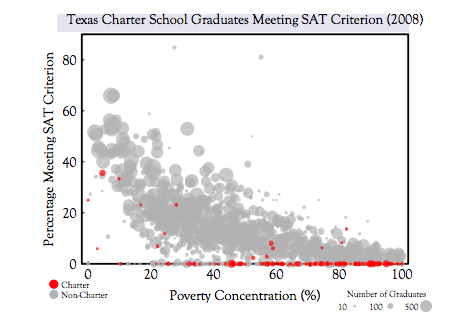
Illustration published here featuring a report by
Dr. Michael Marder, Professor, The Univ of Texas.
While there are several advocates for expanding the charter school phenomenon in Texas it is generally resisted by teacher groups, as well as by associations of school trustees and administrators.  There is an odd mix of political attitudes opposing expansion of charter schools in the Legislature.  It is usually a combination of minority representatives and rural representatives.  In the current session of the Legislature, the fact that the past legislative session cut funding for public education by over $5 billion has thrown cold water, for the most part, on the current attempts to expand charter schools.  Even so, there is legislation authored by some elected officials which  requires that some properties paid for by taxpayers be given or leased to charter schools for a nominal amount of $1 a year.

There are numerous other differences between public schools and charter schools.  For example, charter schools are not required to meet the federal guidelines on free lunches or entrance requirements.  I have often said charter schools simply remind me of families on a tight budget with numerous children who then choose to adopt others, even though they cannot afford the ones they have naturally. 

Public taxpayers should keep an eye on the status of legislative funding of charter schools by simply calling them private schools

[Editor's Note:  In spite of the fact that charters may have admissions requirements, an interesting report and charts like the one above by University of Texas professor Dr. Michael Marder show that public high school students consistently outperform charter school students on SAT/ACT tests. Want a good short explanation in words and pictures? See the chart above and others comparing Texas public high schools and Texas charter high schools in a short movie narrated by Dr. Marder here, and an EdWeek blog article here.]

Wednesday, January 30, 2013

False Slogan


Recent events in mid-western states have caused a setback to organized labor.  Indiana and Michigan have recently adopted so-called right-to-work laws.  Unfortunately, there is very little understanding of what the so-called right-to-work law does. 

While watching TV recently, I observed a local attorney on television who remarked that because Texas was a right-to-work state an employer could terminate an employee at will.  It is clear that even an attorney does not have an accurate understanding of what “right-to-work” laws do.

First of all, the right-to-work law is misnamed in that it gives no one a right to be employed.  In fact, right-to-work laws have just the opposite effect because they give inadequate protection to non-union workers and are grossly unfair to the unions themselves.  The local attorney was correct in that the State of Texas is what we call an “at will” employment state--which simply means an employer can fire an employee for no reason and is only prohibited from terminating an employee for certain prohibited reasons. Those are generally the reasons contained in federal law. The only state prohibition against termination is terminating an employee for failure to commit an unlawful act.

The Texas right-to-work law, as well as those in other states, simply provides that no employee can be contractually or otherwise forced to pay union dues.  The reason such laws are unfair to unions requires a brief understanding of the federal labor laws. 

Under federal laws, unions may organize by receiving a majority vote among a particular group of employees called a bargaining unit.  The majority must vote to bring in union representation.  Once the employees elect to have a union represent them, the union is then obligated to represent everyone within the bargaining unit.  The representation is mandatory for every employee within that unit without regard to whether or not the individual pays dues to the union.

As an example, assume a non-union member is unfairly terminated or disciplined and desires to file a grievance under the union contract.  The union is obligated to pursue the grievance on behalf of the non-union employee even though the employee is a “free-rider,” enjoying all the benefits of the union contract but not participating in financial support of the union.

The situation described above is very like the citizen who would elect to pay no taxes, should he or she have that option, and yet the government would be obligated to furnish police, fire and other governmental services to them just the same as were furnished to taxpaying citizens.  I doubt any rational person would agree that such a situation would be fair to citizens who pay taxes. And the same applies to unions.  The “free-rider” who elects not to pay union dues because of a right-to-work law enjoys all the benefits of the union’s representation and bargaining and yet has a free ride.

Sunday, January 20, 2013

Goings-on for Political Junkies


For many years Texas was a one-party state.  Although statewide officeholders ascribed to being members of the Democratic Party, there were two definite factions of the Party.  There were historic fights between conservative Democrats and the faction which called themselves loyal Democrats.  The largest split came between factions led by Lyndon Johnson and the old loyalist Allan Shivers.  It was said things were so good with Democrats that they needed someone to fight with so they decided to fight with themselves.

There are definite signs that since Texas has become basically a one-party state with Republicans holding all statewide offices and a majority of the Legislature that there are signs of trouble in paradise.

It appears Rick Perry, after having made such a poor showing in his short-lived attempt to run for president, has lost a good deal of his luster among his fellow Republicans.  Some Republicans have decided they have been “waiting in the wings” long enough, indicating there will be a real inner-party squabble during the next election cycle.

It is not a well-kept secret around the Capitol that Attorney General Abbott has let the insiders know he intends to run for governor no matter what other candidate may appear on the ballot–including the current occupant of that office.  Abbott is obviously “feeling his oats” in view of the fact that recent fund-raising efforts have raised him about 4.5 million, on top of the 18 million he has in the bank.  This compares more than favorably with Rick Perry’s recent fund-raising efforts which raised less than 4 million; and unlike earlier times, Perry has only 6 million on hand in his re-election account.

There are other signs that even Republicans are getting somewhat disenchanted with Rick Perry and his long tenure as governor.  Recently, members of the Legislature expressed serious doubts about Perry’s largesse through grants to various funds intended to spike economic growth in Texas.  Even some Republicans are questioning the fact that several million dollars were allocated to friends of Perry who have been donors to his election efforts in the hundreds of thousands of dollars.

A couple of freshman representatives have introduced bills which would bring more transparency to the governor's efforts and another has introduced a bill to prohibit him from double-dipping, drawing both his salary as governor and his retirement benefits as a past member of the Legislature. 

There are other contests already visible on the horizon.  Land Commissioner Patterson and State Comptroller Combs have both announced their intention to seek the office of Lt. Governor; along with Agriculture Commissioner Todd Staples.  All have million-dollar plus war chests already raised and all believe that they are the leading candidate for such office.  In addition to these announced ambitions, it appears Lt. Governor Dewhurst is not ready to give up the ghost, even after his poor showing against Senator Cruz in the recent primary election.  All of the intramural squabbles among Republicans should make for interesting days for those of us political junkies who enjoy watching such goings-on.  Stay tuned.

Ethics and Pay


It is often said, particularly in the service industry, that one gets what one pays for. Fortunately for the citizens of Texas, it is my belief Texans get far more than they pay for in the service of the members of its Legislature. It is no secret that I often take strong issue with the actions, or lack of action, on the part of various legislators. Nonetheless, I developed a keen respect for those willing to give their time and effort in an attempt to make Texas a better place.

Of late there has been some public outcry about ethical lapses of members of the state Legislature. The criticism generally centers around the fact that legislators have outside employment. As an example, a recent news article took to task several members of the Legislature because one ran an insurance agency and voted on matters related to insurance. Another was in the small loan business and was criticized for standing on the floor of the House and defending the industry in which he was involved.  The current rule of thumb, ethically speaking in the Legislature, is that a member of the House or Senate is free to vote for any measure that affects that member in the same manner as everyone else in the same situation is affected. In a part-time Legislature where members of the Legislature receive the princely amount of $600 a month for their service, that seems to be a fair standard of ethical conduct.

Generally, stringent rules of ethics are not very effective in policing ethical conduct--particularly when, as in Texas, the agency charged with policing ethics is more of a toothless watchdog than anything else.  A shining example of the weakness of the Texas Ethics Commission is when they ruled that taking a check instead of cash did not amount to bribery or violate the ethical rules of Texas.

Frankly, with part-time service in our Legislature, I would rather depend on full disclosure by each legislator as to the general source of his or her income, as is now required. The benefit of part time legislators is that they live in the community and generally face the same everyday challenges as do their constituents.  If the folks want to have an insurance agent represent them in the Legislature and vote on matters relative to insurance policies, homeowner decisions, etc., so be it.

If ever the state of Texas wants to get serious about having a serious contingency in its Legislature, the Constitution should be amended to require annual sessions of at least 6 months and pay its legislators about $100,000 per year, as well as awarding them a general expense allowance for the operation of their Austin and local offices.  The annual sessions and the increased salaries should be accompanied by strict rules against outside employment or income.

For years I held forth, to anyone who would listen, advocating better pay for members of the Legislature. But, I have finally reversed my tactics in this matter and now throw in with the naysayers and simply say this:  If you paid a decent salary to members of the Legislature, then any kind of trashy folks could serve, and not just those with trust funds or sufficient incomes to sustain themselves in Austin.

Monday, January 7, 2013

Corporate Welfare


The Republican leadership of Texas continues to act just as what they are–Hypocrites, with a capital “H.”  Recently, Attorney General Abbott and Senator Cronyn were beating their chests claiming they have protected the children of Texas because they have raised the penalties against people who abuse children.  That’s all well and good, but penalties are imposed on abusers of children after the fact.  It does very little for most of the children in the state of Texas.  

On the other hand, Cornyn, Abbott, Perry and others do not seem concerned at all that Texas has more children without adequate health care protection than any other state in the union.  Texas has more children living in poverty than any other state in the union.  

As I’ve said many times before, these great Republican leaders seem to care greatly for the unborn child, throwing roadblock after roadblock against abortions that our Supreme Court has deemed legal.  At the same time, they appear to give little concern, certainly almost no action, to the lot of the children who are already born.

In the wake of recent mass murders, Republicans deny that loose gun laws pose any problem.  They are quick to blame mental health as the root cause.  These same Republicans however are the very folks responsible for starving mental health programs of funding.  In fact, Texas is a prime example of spending more on prisons and less on programs to prevent crimes!

Even more hypocritical are the mental health 'blamers' who refuse to close loopholes in background checks which would allow finding those with mental health problems.

Further evidence of the hypocrisy of our Republican leadership and the majority of the Republicans in our Legislature is that we continue to hear that Medicaid--which offers medical assistance to the elderly and poor--, food stamps and unemployment benefits are a ruination to the state...that they cause people to land in a hammock rather than a safety net.  However, while condemning the so-called welfare to the poor, elderly and needy, Texas has gone headlong into subsidies for the very rich, who obviously are not in great need.  A recent study noted by the New York Times and the Dallas Observer, as well as earlier reports in the Houston Chronicle, revealed Texas government gives away approximately 19 billion dollars every year to corporations in the form of benefits.  These include tax abatements as well as direct subsidies to large gas companies, whose profits are at an all-time high.  It also takes into account the 300 million dollar slush fund which Governor Perry insisted on having at his disposal while we were cutting funds to education by 5 billion dollars.  

Recent examinations of the science companies and start-up businesses subsidy programs insisted on by our governor have revealed a substantial number of them have gone bankrupt or out of business. And study has revealed that another large number of these companies have failed to meet the promised quotas of employees who, they represented, would be on the payroll to help lower unemployment in Texas.  

So, the next time your state representative or state senator starts carping about the welfare state in the United States, remind him or her about the fact that Texas gives away almost 1/4th of the big, corporate welfare sops given in the United States–more than any other state in the union.  Business lobbyists for special interests may call it creating a good business climate in Texas.  I call it a big corporate welfare give-away.