Friday, September 3, 2010

IS IT MUD SLINGING IF IT IS TRUE?


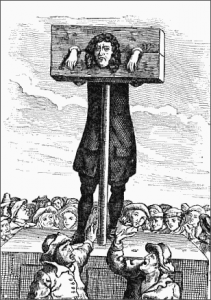
I’m beginning to wonder whether it is worse to reveal the fact that a political candidate is a “scumbag,” or to be a “scumbag.”  Harry Truman once replied when someone urged him to “Give‘em hell, Harry” that he simply “told the truth and the people being told on thought it was hell.”  I have a feeling a lot of the so-called mudslinging that people decry and attribute to their opponent is, often times, actually the truth. And the general voting public ought to hea


A prime example of a candidate being too nice was the occasion when a fellow named Don Yarbrough ran against a fine appellate court judge for the Texas Supreme Court.  There was little doubt Don Yarbrough had a shady past and had a history of association with people suspected of high crimes.  Yarbrough’s opponent, Judge Charles Barrow of the Thirteenth Court of Appeals serving Corpus Christi, Texas, took the fine gentlemanly view that he would not speak ill of his opponent even if it were true.  He left that to the Texas press corps.  The Texas media, both electronic and paper, dropped the ball.  Don Yarbrough, taking the advantage of the name idea of a former candidate for governor of the same name, swept to victory and became one of Texas’ Supreme Court justices. Only a short time later, it was revealed Justice Yarbrough was in fact a crook and was convicted of felonious conduct.  Many Texans went around wringing their hands wondering how this could have happened that a felon could get himself selected by the voters of Texas to be on our highest court.  I suspect these are many of the same people who would be quick to condemn a candidate of speaking ill of his opponent, even if it were true.  
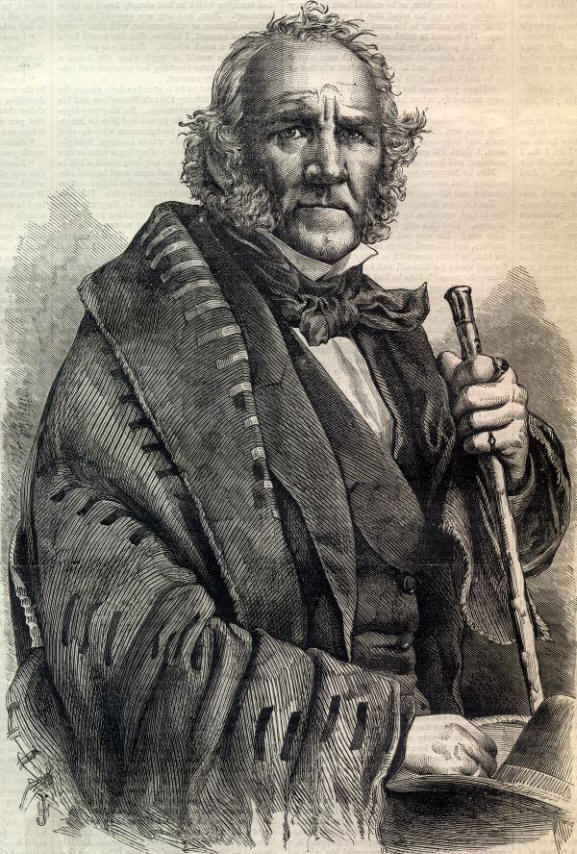
It seems we may have lost something in Texas.  Lusty, rough-and-tumble, passionate politics is not new in Texas.  Reading a history of the elections in which Sam Houston participated, there were instances where candidates would literally pull guns during the course of debates.  Sam Houston once accused one of his opponents of being a bank robber, having stolen a safe from a bank and thrown it in the river. 

While ordinarily it is a good thing that political opponents be civil to one another, doing so to the point of not letting the public know things they should know about one’s opponent does the public a disservice and in a way defeats the whole purpose of the elective process.  We have become too sensitive about confronting one another publicly as candidates for office.   In the good old days a debate was a real debate.  You put two candidates up and let them think of the questions to ask their opponent, or accusations to make for the opponent to refute.  Political debates today have been reduced to nothing more than a scripted news event in which we find out very little about how the candidates feel or what they know about each other.  

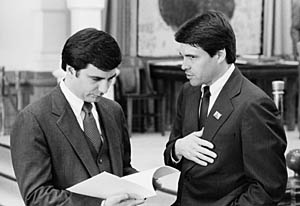
The tepidness of debates today is quite evident by the current debate going on between Bill White and Rick Perry about whether to have a debate.  Rick Perry has chosen not even to submit to interviews by the various editorial boards of Texas’ newspapers, and claims he would not debate with candidate White because White has not revealed enough information about prior income tax returns.  Isn’t this a subject that ought to be debated?  If White had done wrong, or something illegal, wouldn’t it be far more dramatic for Mr. Perry to reveal this charge in the course of debate and demand White to explain it right there on television before God and all the voters?  Alas, I am afraid we have become too civilized to engage in such conduct! Most debates are relegated to the various candidates taking turns answering questions with an occasional “ad lib” off the topic of what the moderator posed as a question.    

Ideally, the open democratic process should be one which gives full disclosure of the good, the bad and the ugly about the candidates.  The candidate with an interest in winning should be the most motivated person or team around to discover all of the defects of his or her opponent and, alternatively, should be most knowledgeable about all of their own good qualities which recommend them as the best candidate for office.  

As for White and Perry, putting aside the gamesmanship and agreeing to a good old fashioned televised debate or a series of debates would be a good start for this election year.


Friday, August 27, 2010

REAL WASTE IN TEXAS

There’s an old joke that defines recession, depression and panic.  According to the joke, recession is a condition where you know someone who has lost their job.  Depression is the situation where your next door neighbor loses his job. Panic, however, is the case where you lose your own job.

It is amazing to me that Texans have not yet caught on to the fact that conservative Republicans’ steadfast and stubborn refusal to take a look at our outmoded method of collecting taxes is rapidly heading Texas in the direction of becoming something like a third-world country.
Although our current governor and several of our leaders continue to vociferously brag about their great management skills in keeping Texas in the “black,” they have done so by cutting short on our most precious commodity--our children and future generations of Texans. 
These leaders and the governor have also managed to balance the budget by smoke, mirrors, tricks and taking advantage of federal stimulus money which they clearly condemned as evil.  Now they are attempting to make draconian cuts in the very things we should be investing in. 

Most politicians make impassioned speeches about investment in our children and future generations of well-educated Texans.  
Unfortunately, too often Texas’ political rhetoric does not match the real commitment. And, in fact, it's the kind of hollow commitment that begins to look like the burned out hull of our once-beautiful Governor's mansion.
You know, while the mansion is under repair, somehow we are able to spend $10,000 per month on the luxurious quarters for our governor’s home, and have built up 9 billion dollars in a so-called rainy-day savings account. 

And yet, Texas ranks dead last in what we spend and what we do for children’s health.

The Legislature finds about $300,000,000 every two years for a slush fund for our governor to give away, mainly to people who generously support his campaign, while we still look to education as the first and largest place to save money to try to balance the budget.

A big brouhaha in Jefferson County has risen due to the Commissioner Court’s stated intention to abolish the positions of nine deputy constables.  This budget-cutting move has sparked large crowds at Commissioners’ Court and even special rallies against abolishing these positions.  

What boggles my mind is the fact that citizens, supposedly so concerned with jobs and good government, seem to be sitting on their hands while the current governor’s administration, in an effort to balance the budget with no change in our tax structure, is gradually dismantling much of our higher education system.

Did you know? The governor has demanded, and for the most part, has obtained a 5% return of last year’s appropriation from the institutions of higher learning.  The 5% cuts demanded by Governor Perry have already cost the University of Texas about 600 jobs; and the governor is calling for an additional 10%.

To bring the situation closer to home we need only to look as far as Lamar State College- Port Arthur.  Even though enrollment has increased by almost 10%, the local college has been required to return 3/4 of a million dollars to the state treasury. Unlike most other parts of the state, Lamar has been adversely impacted in a serious manner by two hurricanes in recent times and is required to find ½ million dollars for windstorm, fire and extended coverage without any help whatsoever from the state.
Far from cutting fat out of the budget, these draconian cuts have resulted in laying off 28 skilled people, closing the Childcare Development Center, imposing a hiring freeze, and eliminating programs in child development, welding, heating and A/C technology, and eliminating training for chemical dependency counselors. Furthermore, even faculty members are unable to continue their own professional developmental training, and summer school has been sharply curtailed.

Unfortunately, these shortsighted cuts in higher education institutions such as UT and Lamar will be felt long after this budget year.  Texas will pay the price in loss of competitiveness, and in having qualified, skilled workers for jobs requiring more and more education and training.  Our institutions of higher learning will suffer nationwide as well as internationally in the loss of high standing to attract scholars, researchers and world renowned professors.

While Texas’ main brag will be, “We balanced our budget with no new taxes,” India and China will be bragging about producing twice the number of computer experts, engineers, scientists and other scholars.

Many economists are predicting that in the coming few years, for the first time, America’s next generation will not be able to do as well as their parents and grandparents.

If they are right, perhaps it's time to take a good look at the panic that is just around the corner for our children.

Voting citizens of this state need to wake up and demand that our elected officials take a realistic view toward providing adequate resources to ensure a decent future for this state and its progeny. Those demigods, who talk the loudest about cutting the size of government and government programs, need to be held to account and explain exactly which cuts they believe to be waste in government.

It will, in all likelihood, surprise the average citizen to know that more tax money at the state level is wasted by giving special interests undeserved tax breaks.

Huge grants are doled out at the whim of the governor in the so-called name of industrial development and wasteful procedures which continue to deal only with symptoms of social and health problems of this state rather than deal with the root cause through prevention. These are the big waste items in Texas government.

And the often talked about welfare mother is pale by comparison.

Friday, August 20, 2010

ANOTHER LOOK AT FREEDOM OF THE PRESS

Thomas Jefferson, more than any of our founding fathers, valued a free press.  Thomas Jefferson equated a free press with liberty itself and as an essential ingredient equal to or superior than most of our Bill of Rights.  Thomas Jefferson, however, once declared, “A declaration that the federal government will never restrain the presses from printing anything they please will not take away the liability of the printers for false facts printed.”  

One of the great myths, if not the greatest myth, propagated by publishers in the United States is the quote, “The people have a right to know.”  No where in our United States Constitution is there a written right to know on behalf of the public.


It is my firm belief that, where enthusiasm protecting a free press in the United States has gone astray, we should concentrate on the public’s need to know, not necessarily a right to know.  Clearly, the public needs to know everything about a potential officeholder which affects his judgment, honesty, dedication to public safety or any attribute bearing on his ability to fairly represent the public or perform ably in his or her duty.  The public does not necessarily have a right to know whether a gentleman in public office wears briefs or boxers.  

It wasn’t until the late 1700's in the United States that truth was a complete defense to libel and slander.  The Zanger trial created the defense of truth.  Unfortunately, in my opinion, courts have gone too far the other way in the protection of an uninhibited free press.  It has always been my position that if the public has a right to know, the public has a right to know the truth.  It appears to me it does little to preserve a free, American democracy, if we protect a lie.  

The press’s theory is that it cannot be looking over its shoulder and should be able to be uninhibited in reporting--particularly on public figures who choose to thrust themselves into the limelight.  With the case of New York Times v. Sullivan, the courts probably went a step too far.  In order to hold the publisher of an out-and-out lie responsible for slander, it is necessary for a public figure to not only show that a lie was published, but that the lie was done maliciously with an intent to injure the person about whom the lie was published.

As the printed press was a giant leap forward in transmission of information and knowledge to a broader spectrum of readers, recent electronic gadgets and ways to share information have made an equal leap forward in the ability to communicate.  We now have radio and television; but even probably more important, we have the internet, blogs, face books, text messages, and God knows what else.  Not only is it easier to publish information, it is also easier to verify or check the facts of information published.

A frequently published blog in Jefferson County recently outlined in great detail a story claiming a state senator had arrived at a motorcycle rally at the bridge to Pleasure Island in Port Arthur.  The blog went on to claim the state senator was confronted by a policeman demanding to know whether or not the senator had a gun.  According to the story published in this blog, when the senator protested about being asked such a question, the policeman in charge simply told him he could hit the road because Port Arthur did not particularly like people of his kind coming to Port Arthur.  


In view of the fact it seemed to be a black mark against Port Arthur and its finest law enforcement officers, and since I knew the senator personally, I took the time to pick up the phone and call the senator.  It turns out the blog was a complete fabrication; not containing a grain of truth.  A rhetorical question occurred to me: why should such misinformation have the same protection as a legitimate news source? 

I have recently published an opinion piece on why I think our legal system can enforce personal responsibility of peoples’ conduct.  If you run over someone, you attack someone or you spill millions of gallons of crude oil into the Gulf of Mexico destroying peoples’ livelihood, why shouldn’t you be held to account for such bad conduct?  The same would be true with regard to slander of an individual, whether a private citizen or a public figure.  Why should publishers have protection from the consequence of shoddy or untruthful reporting?

I submit freedom would be better protected if those publishing alleged facts were held to account as Thomas Jefferson suggessted for publishing untruths.  The best way to hold them accountable is to make them liable for not checking the facts, willfully publishing false facts, or setting out maliciously to hurt someone.  I submit democracy and a believable press would be better served by making those who publish accountable for publishing the truth.

Thursday, August 12, 2010

THE TEXAS SUPREME COURT SIDES WITH CATTLE RUSTLERS OVER JURORS

One of the great principles of a free Democratic society is that citizens can carry their grievances to a court of law and have it settled by a panel of jurors of their peers. In Texas juries generally consist of ordinary citizens who usually vote and volunteer to participate in one of the vital functions of a Democratic society; i.e., a jury trial.

Of late, our Texas Supreme Court more and more has demonstrated its contempt and distrust for the judgment of citizens who hear the firsthand account of facts related to legal disputes. In the last two years the Texas Supreme Court, unlike the courts for many years in the past, has overturned a majority of jury verdicts which have reached them. In the recent case of Bennett v. Reynolds, eight of our esteemed Republican judges have sided with the judgment of their own over that of citizen jurors, all to the benefit of a cattle thief.
This Wild West story began in San Saba County where several of Mr. Reynolds’ cattle wandered over the line onto property belonging to a corporation run by Thomas O. Bennett, Jr.  Mr. Bennett directed employees of the corporation which he ran to gather up Mr. Reynolds’ cattle, take them to auction and sell them. Later on, an employee of Mr. Bennett’s corporation, blew the whistle on the whole deal, even though Mr. Bennett attempted to bribe him with the offer of a very lucrative job to keep him from “spilling the beans” on the stolen cattle. When bribery failed to work, Mr. Bennett had one of his employees threaten the whistle blower with bodily harm. Even that didn’t deter the case from going forward and ultimately reaching a jury of twelve citizens. Even with all of that, Mr. Bennett didn’t give up trying to cover up his evil deeds. He tried tampering with the evidence by altering brands on the cattle and doctoring certain photographs of the stolen cattle at the cattle sale. Bennett even resorted to trying to use the court to intimidate the witnesses against him by filing a slander suit against the ranch hand who had told on him. 

The jury heard all of Mr. Bennett’s despicable conduct and in view of the fact the old fashioned remedy of hanging cattle thieves was not available to them as an option of punishment, they resorted to punishing Bennett and his corporation to the tune of $1,250,000 in punitive damages. The whole purpose of punitive damages is to punish the wrongdoer, but also to send a message to would-be wrongdoers that they will be dealt with very harshly by our Texas judicial system.

Of course, Bennett promptly appealed to the Court of Appeals which dutifully upheld the judgment of the jurors and trial court. Undeterred and unrepentant, Bennett appealed to our Texas Supreme Court. He argued that since his ranch was owned by a corporation, the corporation couldn’t be held liable for punitive damages; and besides that, only stealing a dozen or so cattle amounting to $5,000 was not a serious enough matter to subject him to such punishment. He further argued the threats to the witnesses, jury tampering, altering evidence and other skullduggery he did in connection to his main crime was of no consequence and should not be considered.

Well, the Supreme Court finally showed their true colors. After some mouthing about how Texas really didn’t like cattle rustlers, they proceeded to reverse the jury verdict saying the punitive damages were far in excess of the seriousness of the crime to be justified. In effect, they let the cattle thief off the hook. Who would have thought it? A Texas high court deciding with the cattle rustlers against twelve jurors, tried and true!

Saturday, August 7, 2010

WHAT’S HAPPENED TO INDIVIDUAL RESPONSIBILITY?

Assuming responsibility for one’s own actions is as American as apple pie.  I dare say 99% of the American population would agree with that particular principle, but where has it gone? 

Attacking government seems to be a growing sport in today’s world.  Almost any time one can find someone on television or radio holding forth about "creeping socialism" taking hold of our government, and that government itself is strangling individuality.

Common complaints are that government is interfering with business, discouraging free enterprise and stifling individualism.  Business lobbyists claim industry is over regulated, that the current administration is anti-business; and all of this together is responsible for the downturn in the entire world economy.  Almost everyone believes themselves to be overtaxed and that our U.S. government is giving away our money faster than they can extract it from us.  

If anything is to be learned from the BP oil spill disaster and recent explosions, it is that there is not enough regulation, at least of the oil industry to make the public, workers, and/or our environment safe.


You can rest assured that BP will spend millions, possibly billions to avoid as much of its responsibility as possible.  In the end BP will argue they adhered to government regulations and that their damages should be capped by an act of Congress so they do not face unlimited damages for what they have wrought on our beaches, marshes, and with our marine life.

It is only necessary to read a daily newspaper on a fairly regular basis or be a close observer of the world news to become aware that special interests and big money in the U.S. is spending millions on thousands of lobbyists to avoid responsibility for harm, damages and cost to others.  The lobbyists like to give their objectives cool names such as Fighting Socialism, Avoiding Over-Regulation or Tort Reform.  Stripped of the nice trappings, in short, these should simply be called Avoidance of Responsibility.

Child psychologists and scholars of penal systems all agree the best way to deter bad conduct is to make bad consequences flow from bad acts and make the assignment of responsibility swift and sure.  Our American tort system has the advantage of doing that.  It is designed to hold people accountable for their wrongdoing and in a way that most big business understands.  If you don’t adhere to proper standards and you injure someone or someone’s property, you are responsible and must pay out of your pocket.  

Thousands of lobbyists in Austin and Washington are busy every day trying to destroy this system.  The public posture of most lobbyists is that their industry welcomes regulations.  Of course they welcome regulation, but not too much. They especially welcome regulation if it deters competition in their field.  

These business lobbyists always argue that government regulation should protect them from law suits or claims.  They argue business adheres to government regulation that should be adequate to avoid responsibility for any bad consequences which ensue.  Unfortunately too often industry writes those regulations and rules.

Ask yourself if you can remember any circumstance where government regulation has adequately protected the public. Government regulations, for example, were adhered to in the manufacture of the Pinto which turned out to be a flaming death trap for more than one family. 

How about medicine?  How many times has FDA approved medicine which resulted in death or disastrous disability for unwary patients after being approved by this government agency?  

How well do you think government regulation has prevented insurance companies from cheating their customers?  Or, lending institutions from unfairly foreclosing families’ homes?

Recently, the federal EPA has found that the Texas Commission on Environmental Quality has wholly failed in its responsibility to adequately prevent poisonous emissions in Texas.

Unfortunately, in too many instances the government agencies responsible for regulating a particular industry rely too heavily on input from the industry and in some cases all but let industry lobbyists or representatives write the very regulations they are to be governed by.  The federal agency responsible for licensing and approving drilling and procedures for drilling in the Gulf of Mexico was one such agency. 

It has now been revealed the oil industry, the drilling industry and their regulators were so cozy they exchanged gifts, socialized together, and generally supped from the same table.  As a result, thousands will be unemployed for the foreseeable future and in all likelihood there will be a shortage of seafood for the average family.  The surviving families of those killed on BP’s rig will continue to suffer without their breadwinners.

So, the next time you see some “talking head” railing that what this country needs is less government restriction, stop allowing lawsuits, stop allowing jurors to hand out justice, this is nothing more than another way to escape personal responsibility for their own wrongdoing.

Tuesday, July 27, 2010

REAPING WHAT YOU SOW

What would you think of a farmer who was persuaded to plant less of his crop in order to spend less money on the harvest.  It would not take a rational person long to decipher that by planting less and less and harvesting less and less, you would eventually have less and less income until eventually you had nothing. 


Unfortunately, like the foolish farmer, recent Texas leadership is doing the same thing.  A candid look at Texas reveals we are beginning to lag behind other states more and more in productivity and economic growth.  In large measure this phenomenon is tied to the fact a majority of the Texas leadership, especially our governor, refuse to invest in the future of this state.

This state is lagging behind and rapidly approaching the status of a third-world country, not because we have spent too much or even because we have taxed too little.  It is because of the fact we have not made wise investments of our tax money in the future of this state.  For the last several years we have continued to elect people to be in charge of our public school system’s long-range policy who hold public education in contempt.  Instead of concentrating on improving the quality of our state pubic education system, they continue to seek ways to circumvent it and cast too much of our educational resources in the hands of private or so-called charter schools.  They have moved the investment of the public education funds from the hands of experts in investment and made it a political matter placed in the hands of amateurs who are motivated more by political persuasion than training in economics.

Our legislature continues to believe that quality of education can be enhanced by “gimmicks” and not by solid investments.  Instead of seeking remedies for poor scores on evaluating testing, we have artificially raised our test scores by lowering standards.  The state has shirked its responsibility mandated by our constitution by shifting the responsibility of funding public education from the state to local school districts.  Instead of making funding of our state public education system a first-priority item, our legislature has forced an ever-increasing tax burden on homeowners and small businesses in the form of property taxes.  Legislators and other state leadership have ignored the fact the cost of ignorance is far more expensive in the long run than the price of quality education.  Our governor continues to boast about how well Texas ranks in the nation, ignoring the fact our public education system is rated by all experts in the field at 44th or 45th of all the 50 states of the union.

In the field of public education, where Texas once was a leader in the nation in providing affordable higher education to its citizens, Texas is quickly turning our public institutions into private colleges beyond the reach of middle-class Texans.  Instead of investing in higher education, the Legislature has authorized local boards of regents to set tuition wherever they choose.  While not alleviating the financial needs of college to a great deal, we have in fact tripled and quadrupled the cost of higher education in this state for many of our citizens.  Too many members of our state government regard research as academic snobbery, and the attractions of merit scholars and distinguished professors to be a waste of money.

For shortchanging public and higher education in this state, future generations will continue to pay the price of having the lowest paying jobs in the country, attracting fewer and fewer high-end industries and eventually continuing to rank with the most backward states of the nation.

Failure to take a holistic and long-term view of other social problems will ultimately ill serve our state.  Our penal system is a prime example.  While we rank with several nations of the world with the number of people incarcerated, we refuse to take full advantage of alternate systems of judicial punishment.  Most who have studied the system realize corrective punishment and rehabilitation can be accomplished at a fraction of the cost of incarceration behind concrete and steel.  Intensive incarceration can be as costly to Texas taxpayers as keeping a medical student in our finest medical school.  We could easily double our number of parole and probation supervisors. And benefit with greater results.  We could accomplish punishment and rehabilitation, while at the same time allowing those convicted of non-violent crimes to be productive, and in large measure, pay for their own punishment.  Many of the draconian punishments insisted on by law-and-order advocates in our legislative system have not resulted in Texas having the lowest crime rate in the nation.

A failure to take a long-term view of our health problems in this state have resulted in the waste of millions and millions of dollars.  Failure to spend what is needed for the health of children in this state has caused us to leave millions on the table to be spent in other states; partially funded by money sent to Washington by Texas’ taxpayers.  Texas has little or no preventative medicine program for those citizens here in the greatest need.  As an example, Hispanic Texans have and suffer from five times the incidence of diabetes as Caucasians.  It is well known and established in medical circles that identification of diabetes and conservative treatment through change of lifestyle and diet can control well over 50% of the incidents of this dread disease; and yet, Texas has virtually no program in place to address these needs.  Instead, our Texas health program will spend billions on the aftereffects of diabetes and only a pittance on its prevention.

Until the voting citizens of Texas start demanding investment in the future rather than platitudes and empty brags, our state will continue to lag behind many other states of this union, not taking full advantage of the precious resources of this state, which include future generations of Texans.

Saturday, July 17, 2010

SLEAZY CONDUCT CAN STILL AFFECT THE OUTCOME OF ELECTIONS

It appears some Republican operatives have a history and tradition of sleazy conduct. The sleaziest that comes to mind was the burglary of Democratic headquarters in Washington which resulted in the resignation and impeachment of President Nixon. Apparently, the tradition of underhanded conduct by political operatives favoring Republicans is still alive and well.

Recent news reports bring to light the South Carolina U.S. Senate race where the Democratic nominee, Mr. Green, was arrested and unable to post bond and filed a pauper’s oath in order to be released on his own recognizance awaiting trial. Just a few short months later, Mr. Green managed to scrape up slightly more than $10,000 to get himself on the ballot as a candidate for the Democratic nomination as the Senator for South Carolina.

Mr. Green has been unable to explain to anyone where the $10,000 plus filing fee came from or how he managed a campaign after having himself declared poverty stricken. Suspicions abound his financial angel was not necessarily a Democrat, but someone bent on trying to divide the Democratic votes in November, or at least dilute them, to the benefit of the Republican nominee. We had a slightly similar experience in our own area in 2008 with our state senator experience.

If you will recall, Chris Bell, a former candidate for governor in Texas, ran along with several others to be the state senator for district 17. The creation of thisdistrict alone was enough to raise some eyebrows about fair-minded politics. The district was gerrymandered so that it runs from the North side of IH-10 on the West side of Houston, down through coastal counties, including half of Galveston Island, through Chambers County, through a narrow strip of land where there are
no humans, Sabine Pass and reaches up and takes in Port Arthur, cutting it off from the rest of Jefferson County.

Chris Bell emerged as the favorite receiving 85,725 votes in the first special election. There was speculation Chris Bell could possibly win the seat without a run-off, and in all probability would have, except for the fact that near the filing deadline a second Democratic candidate showed up in the form of Stephanie E. Simmons. Ms. Simmons is an African-American whose residence was extremely questionable. She claimed a residence where her grandmother had lived in one of the counties just South of Harris County, but numerous investigations and visits to the house seemed to indicate Ms. Simmons had never lived there.

Further investigation revealed Ms. Simmons had been encouraged to join the race by former Representative Ron Wilson, an African- American member of the House from Houston for several years. Mr. Wilson had been rejected for re-election by his constituency in Harris County largely due to the fact he continued to vote more with Republicans than Democrats. The final straw was the last session of Mr. Wilson’s service when he was a strong ally and advocate for Speaker Tom Craddick, as well as Tom DeLay. Being bitter about being rejected by the people in his own district, Wilson became fairly active on behalf of many other Republican candidates.

Coincidentally, his lobby business picked up and was hired as assistant parliamentarian by then Speaker Tom Craddick. Although Ms. Simmons did very little in the way of campaigning, spent almost no money, she managed to garner 30,839 votes or approximately 13% or 14% of the total; just enough to make sure Chris Bell was not able to win it all in the first general special election. Unfortunately, in the runoff between Chris Bell and the Republican Joan Huffman, 179,622 voters which had shown up at the polls in the first election failed to return and exercise their right to vote. Bell, who had received almost 86,000 votes in the first election, received 19,176.  Huffman, who had received 58,000 in the first election, received 24,497, and is now State Senator for District 17.

It appears Republicans in Texas are getting a little nervous about their favorite son, Rick Perry. Recent articles and polls show Rick Perry and Mayor Bill White are virtually neck-and-neck. White appears to have moved ahead with a few revelations concerning Perry’s record in office. So, here we go again with the sleaze.

Out of the blue a petition has arrived in Texas containing several thousand signatures asking that the Green Party be included on the November ballot. Green Party candidates have not scored enough votes in gubernatorial races to entitle
them to automatically be on the November ballot. To obtain such entitlement requires about 5% of the total vote, and the best the Green Party has ever done has been about 2%.  It is widely believed among political observers that Green Party candidates generally siphon votes away from Democratic candidates.

Well, it appears most of the mystery has been solved. Mike Toomey, a former State Representative and well-known Republican activist has admitted paying approximately $12,000 to an official of the Green Party to attempt to gather enough signatures to get the Green Party on the ballot.

Apparently, the Green Party official got cold feet about the source of the money he was receiving and backed out. The slack was apparently taken up by approximately ½ million dollar contribution made by some anonymous corporate source from out of the state to hire people to produce enough signatures to qualify the Green Party for the November ballot. Involvement of two of Perry’s staff has recently come to light. It looks just like an underhanded scheme Mike Toomey is capable of.

Toomey’s history is that after leaving the Texas House he became a very well-paid lobbyist and then a staff member for Governor Clements. Upon leaving Clements office, he went back to lobbying and showed up next as an aide to Rick Perry. His most notable accomplishment was to persuade Perry to issue a gubernatorial order that young girls be vaccinated with a vaccine to prevent cervical cancer. Aside from such an order being invasive to the privacy of young women, it also revealed Toomey, his number one aide, had been the lobbyist for the manufacturer of the vaccine. In such a case it was not too hard to connect the dots. In Republican politics, the rule is always to follow the money.

A district judge in Austin ruled the Green Party off the ballot. The Party took its appeal to the all-Republican Supreme Court which promptly lifted the stay pending further review. Even though more and more evidence emerges the scheme to dilute liberal votes was hatched in Governor Perry’s “shop,” odds are the Green Party will remain on the ballot. Our Supreme Court once again will demonstrate it has the ability to rise above principle for the sake of politics.

Thursday, July 1, 2010

MAKE BELIEVE EDUCATION


Back in the early 1970's when the Texas Supreme Court  ruled our system of funding public education in Texas was unconstitutional, Republicans, led by Representative Culberson, now a member of Congress, had some unique ideas on how to meet the challenge.  The Court held our state’s constitution required the State Legislature to provide all of the school children of Texas with an equal opportunity for a quality education.  Representative Culberson’s solution was simply to amend the Constitution and remove the provision guaranteeing quality of education.

Under the leadership of Governor Perry it seems the Republican mantra has not changed a great deal.  By all measurements among public education systems in the United States, Texas is ranked either 46th or 45.th 

Primarily, we are ranked so low because we have a state board of education which is the laughing stock of the country. In fact, there's a substantial number of conservatives in the Legislature who would just as soon see public education dismantled. In fact, state support for education has eroded substantially in Texas.

In the 1940's Texas was among the leaders in the nation in funding and caring for public education.  At that time the state furnished about 60 to 65% of all funding for the state education system.  Now, we are down to somewhere around 30%, and have an education system mandated by the state but basically funded locally.  

While bragging about no new taxes, the State Legislature continues to force homeowners, small business owners and other property owners to do what is the constitutionally mandated duty of the state. 

To make matters even worse, Governor Perry has grandly turned down the opportunity to compete for several billions of federal dollars stating he is afraid federal bureaucrats will lower the standards for Texas.


Texas would have to lower standards? Hardly. In fact, we're below the national norm now. How on earth could we be in any worse shape as far as demanding accountability from our educational system?
  
Governor Perry, while making political speeches, brags about what a great system of education we have in Texas--a brag which will not stand close examination.  Those in charge of public education in Texas have now devalued the TAKS test which has been used for several years as the measurement of accomplishment of students in public education.  State bureaucrats, along with Governor Perry, have hailed higher scores on standardized tests administered throughout the state’s system.  

What they fail to reveal is the fact they have lowered the standards so that it is now a lot easier to look as though the students are doing better in the various categories. 

To me it certainly takes gall for the governor of a state to stand bold-faced in front of his constituents and brag about a public education system where only 38% of 4th graders were rated as proficient in math and 28% in reading.  This is according to national “normed” tests--tests taken by all other students in the nation.  

However, to show you the difference, the Texas test shows that a whopping 86% passed the TAKS in math and 84% in reading. How could they fail the national test and pass the Texas test with such flying colors? 


There are several problems with our governor's brag about having a great system and the way it measures accomplishments of our students. First of all, it's a lie. Governors shouldn't lie to their constituents. Second of all, it keeps Texans from really knowing how badly off we are and from being motivated to do something about it. 

As a leading educator in the United States pointed out, we may fool ourselves temporarily, but eventually Texas’ students are going to have to compete with students in the rest of the world.  


We are building a trap for the future of our Texas kids, and the blame should be laid at the foot of our current governor and his cronies who value politics over productivity.
_____________________


And one further note:  Subsequent to this posting of Senator Parker's article, the Commissioner of Education has announced yet another iteration of testing that started 1980 with TABS [Texas Assessment of Basic Skills] and five years later the test was changed and recast as TEAMS [Texas Assessment of Minimum Skills]. Then in the early 90s the test was changed again to TAAS [Texas Assessment of Academic Skills], to be followed a few years later by TEKS [Texas Essential Knowledge & Skills] and then a short time later in the spring of '03 this became TAKS [Texas Assessment of Knowledge & Skills]. Now comes STAAR, the State of Texas Assessments of Academic Readiness. It may be significant to note that none of the previously installed tests ever reached their full implementation--all were implemented on a multi-year phase-in process, such that, in order to be accredited in the first year, the schools had to achieve only 25% passing, and then the pass rate was inched up 5% per year. The TAKS 2010 standard for academically acceptable was 70% passing in Reading, 70% Writing, 70% Social Studies, 60% Mathematics, and 55% Science. Keep in mind that this is the standard for the percentage of students passing. In other words, in each school, depending on the subject, the school could have been rated as "acceptable" for anywhere between 30-45% of the students to actually fail the test. But that's not all. Another measure, a so-called ''projected" success rate, is sometimes used to waive certain students' failure to pass this year because it looked like they were improving at a rate that was ''on track'' to pass somewhere further on up in their schooling before they graduated [See Texas Tribune: Projecting Success of Failing Students Often Wrong]. Some educators have been overheard to call this the ''pixie dust'' or educa-mystical approach to accountability, magically changing a school rating from 'unacceptable' to 'acceptable'. [THH - July 12]


Friday, June 25, 2010

HEADLINES ARE SOMETIMES MISLEADING


In reading The Houston Chronicle a headline jumped out at me which I thought at first glance was the most idiotic idea ever published by a reputedly rational human being.  The headline stated, “Let markets regulate offshore oil industry.”  My first thought about this headline was that letting the oil industry regulate environmental matters would be like allowing drug cartels to regulate law enforcement related to drugs.

On closer examination of the article I actually found a couple of ideas worthy of consideration.  The theme of the article was that government had precious little expertise in trying to regulate offshore drilling.  In an effort to make up for lack of knowledge and up-to-date technology, the government would over regulate and thereby stifle the industry, ultimately driving prices up at the pump. 

Two decent ideas were central to the writer’s proposal.  The current artificial restrictions limiting liability on the open seas should be adjusted to more realistically reflect the times.  Congress, some years back, artificially limited liability for marine disasters including offshore floating rigs to 75 million dollars.  This limitation is based on the Oil Pollution Act of 1990.  Limitation of any kind of disaster on the seas has its roots in the old admiralty law of limiting liability of ships to the value of the ship and its cargo.  

Obviously, limiting the liability of a multi-billion dollar drilling operation at sea only to the value of the hardware is a far different creature than limiting the liability of a sailing sloop laden with rum from the Caribbean.

The drilling industry and its defenders are quick to point out there have been over 36,000 deep wells drilled in the Gulf of Mexico and only two major incidents.  They point out that although the risks are great, the probability is only slight. [Picture at left from 

The issue of high risk and low probability could be applied to atomic warfare which the world has chosen to treat in a vastly different manner.  Even though it is not very likely we will have nuclear explosions throughout the world, world opinion has caused nations to band together with nuclear ban treaties and in joint efforts to stop the proliferation of atomic weapons which could lead to a remote possibility of such a mess. 

The writer of The Chronicle  article goes on to argue that only the industry has the expertise to control and figure out the safest methods of operation.  Industry, facing greater liability, would seek insurance to cover that liability; and the insurance companies would in fact be the regulators, inspectors and controllers of safe operation. 

I don’t know about the rest of the world, but I for one am not ready to put the safety of fragile coastal waters, marshlands and birthplace of most marine life in the hands of insurance adjusters or even inspectors. 

The extent of devastation caused by drilling failures such as the current one, as well as the one in the Bay of Campeche, much like nuclear war, poses too great a risk for even 1 in 39,000. 

While it is true government inspectors probably do not possess the expertise or technology available to see that safe operations take place , such expertise by trained and intelligent scientists could be easily developed at the national level; and it should be.  Additionally, there should be no limits on responsibility for negligence in allowing disasters of the kind we now face.  Companies should be responsible to the full extent of the damage caused by their negligence. [See live video from robots at BP site where an estimated 2.5 million gallons of oil per day are spewing up into the Gulf. ]

Next, President Obama’s idea of a fund created to make those damaged by oil company operations whole is a good idea.  While I would not advocate unlimited funding to the tune of multiple billions, I would begin a charge for each well drilled in the Gulf of Mexico so that a fund could be built up to say 100-billion dollars and then capped until it was required to be used.  A small tax or fee could be reimposed to replenish the fund.  By using this method, we would not be forced as in the Valdez cleanup in Alaska to wait for 25 years or so for people damaged to be made whole. 

One thing we will learn from this disaster.  I am certain we will be able to separate the sheep from the goats.  We will soon know which members of Congress care more about the earth, the ecology and the people of this land than they do the oil companies.  Stay tuned.